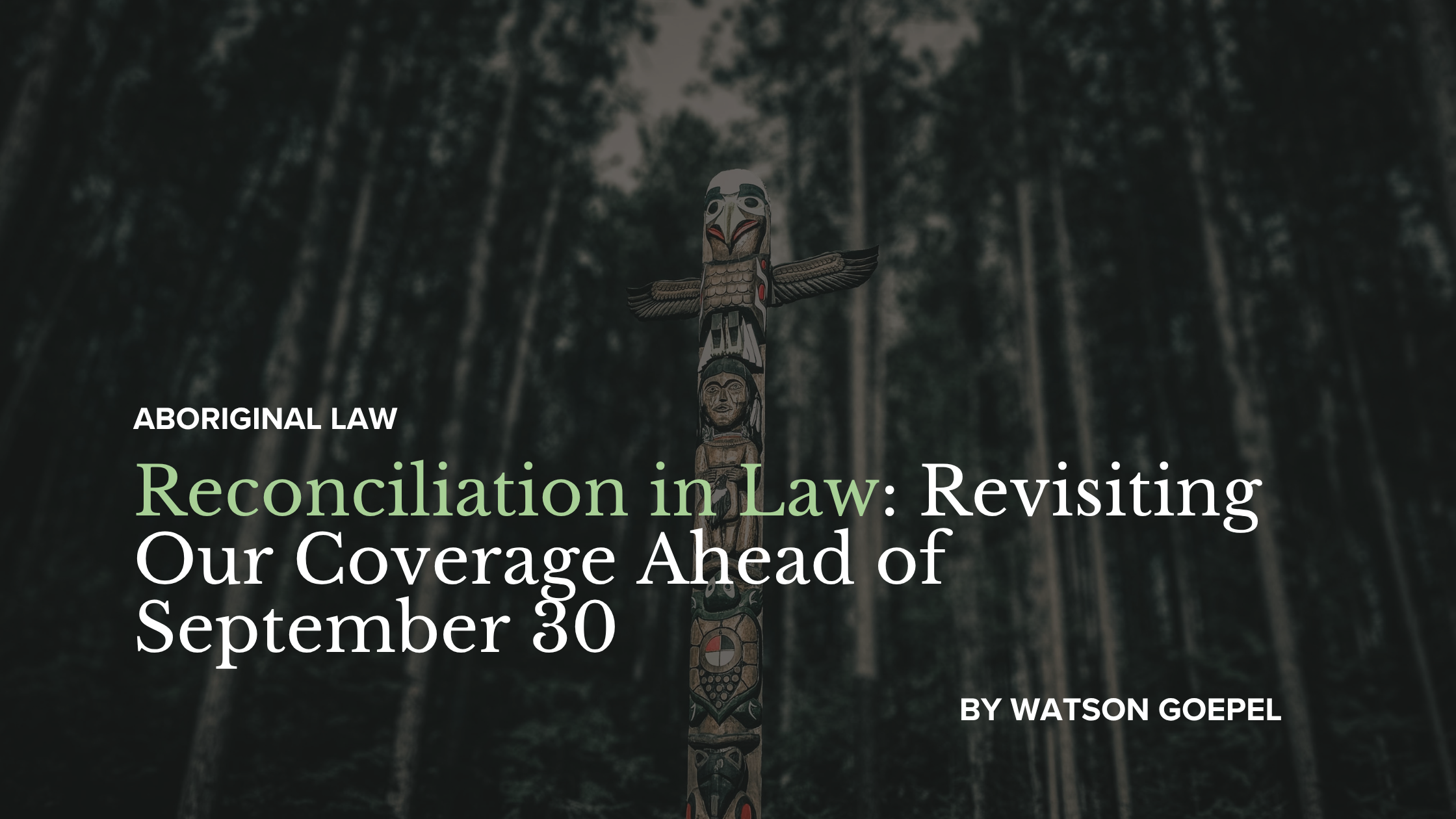
Reconciliation in Law: Revisiting Our Coverage Ahead of September 30
Every September 30, the National Day for Truth and Reconciliation asks Canadians to reflect on the legacy of residential schools and on the ongoing relationship between Canada and Indigenous peoples. It’s also a moment to look back at how the law itself has been evolving in response, from national commitments like the Truth and Reconciliation Commission’s Calls to Action, to provincial legislation like BC’s Declaration on the Rights of Indigenous Peoples Act (DRIPA), to the court decisions now testing what those commitments mean in practice.
Associate Counsel Anita Boscariol, former Director General, Treaties and Aboriginal Government Negotiations West for the federal Department of Indigenous Affairs and Northern Development, has followed this evolution closely in our Insights over the past two years. Ahead of this year’s National Day for Truth and Reconciliation, we’re revisiting that coverage.
Where It Started: The TRC’s Calls to Action
As the Truth and Reconciliation Commission’s landmark 2015 report approached its 10th anniversary, Anita took stock of what had actually changed. In “Progress Made on the Truth and Reconciliation Commission’s Recommendations,” she traces the path from the federal government’s 2008 apology through the TRC’s 94 Calls to Action, and what’s been achieved so far.
She followed up with “Truth and Reconciliation in Canada: Progress, Challenges & the Path Forward 10 Years After the TRC Report,” going deeper on more recent advancements, including Indigenous-focused training for law enforcement and the judiciary, the expansion of restorative justice programs, and new reconciliation agreements recognizing Indigenous self-governance.
Turning Commitments Into Law: UNDRIP and DRIPA
Reconciliation is not only about acknowledging the past; it also requires embedding Indigenous rights in BC law. In “BC’s Declaration on the Rights of Indigenous Peoples Act: Rising to the Challenge of UNDRIP,” Anita explains how BC became the first Canadian jurisdiction to incorporate the UN Declaration on the Rights of Indigenous Peoples into domestic law and examines the debate over its legal force.
In “The Implementation of UNDRIP in Canada & BC: What Does This Mean for Indigenous Women and Girls,” she then examines what implementation means for Indigenous women and girls, linking UNDRIP to the TRC’s Calls to Action on their treatment in the justice system.
Where It Stands Now: DRIPA and Aboriginal Title Being Tested
Most recently, Anita has been tracking how these commitments are playing out in real disputes. In a CityNews interview recapped in “Anita Boscariol Breaks Down B.C.’s Proposed Suspension of DRIPA,” she explains the Gitxaala decision confirming DRIPA has immediate legal force, and what the BC government’s proposal to pause parts of the Act could mean for Indigenous Nations and future litigation.
On The Vancouver Life podcast, recapped in “Does Aboriginal Title Affect Private Property in BC?,” Anita unpacked the Cowichan land claim decision, where the court found BC owes the Cowichan Nation a duty to negotiate in good faith, without automatically cancelling private ownership in the area.
Ways to Take Part This September 30
Reconciliation isn’t only a legal question — it’s also about individual action. In “Ways to Learn & Grow This Truth and Reconciliation Day,” we rounded up ways to get involved locally: Lower Mainland events, books by Indigenous authors, and organizations doing meaningful work in the community, along with a look at how the Law Society of BC’s Indigenous Framework and the Canadian Bar Association’s resources guide lawyers specifically in advancing reconciliation in their own practice.
Read More From Our Indigenous Law Group
You can find Anita’s full background and ongoing work in Indigenous law on her team profile. If your organization has questions about Aboriginal rights and title, consultation and accommodation, or Indigenous governance, our Indigenous Law Group is here to help.
Disclaimer: This content is provided solely for informational purposes and is not intended for use in any legal proceeding. You should consult a qualified lawyer for advice tailored to your specific circumstances.