Go to content
Move forward with confidence. Contact Watson Goepel LLP today. Call 604.688.1301.
The Hague Convention and International Child Relocation

The Hague Convention and International Child Relocation

We help parents manage international child relocation disputes, coordinate with foreign authorities, and achieve enforceable solutions under the Hague Convention.

Protecting children across borders.

The Hague Convention on the Civil Aspects of International Child Abduction is an international treaty designed to protect children from wrongful removal or retention across international borders. In family law matters, the Hague Convention provides a legal framework to ensure that children are returned promptly to their country of habitual residence and that custody and access disputes are resolved fairly.

Key points about the Hague Convention:

  • Applies when a child under 16 is wrongfully removed or retained in a country that is a Hague Convention signatory
  • Seeks to restore the child to their habitual residence as quickly as possible
  • Respects the child’s best interests while upholding parental rights
  • Provides a clear process for courts and authorities to handle international child abduction cases

How we can help:

  • Advising parents on rights and obligations under the Hague Convention
  • Assisting with applications for the return of a child to their home country
  • Representing clients in courts or liaising with authorities in other countries
  • Coordinating with international legal counsel to navigate cross-border matters
  • Ensuring compliance with court orders and monitoring enforcement

Navigating international child relocation disputes can be complex and emotionally challenging. Our team provides clear guidance, strategic advocacy, and practical solutions to protect your child’s safety, uphold your parental rights, and ensure compliance with international law.


Recent News

View All
  • Family Law

Jurisdiction and Property in Cross-Border Family Disputes: Lessons from Florescu v. Lodato, 2025 BCSC 1950

Danica Beck

Jurisdiction plays a critical role in cross-border family disputes, particularly when property division spans multiple countries. In this case,the Supreme Court of British Columbia demonstrates how and when it may decline jurisdiction in favour of a more appropriate forum. This case highlights the importance of early jurisdictional strategy to avoid parallel proceedings, reduce costs, and ensure disputes are resolved where they are most closely connected.

Read More
  • Family Law

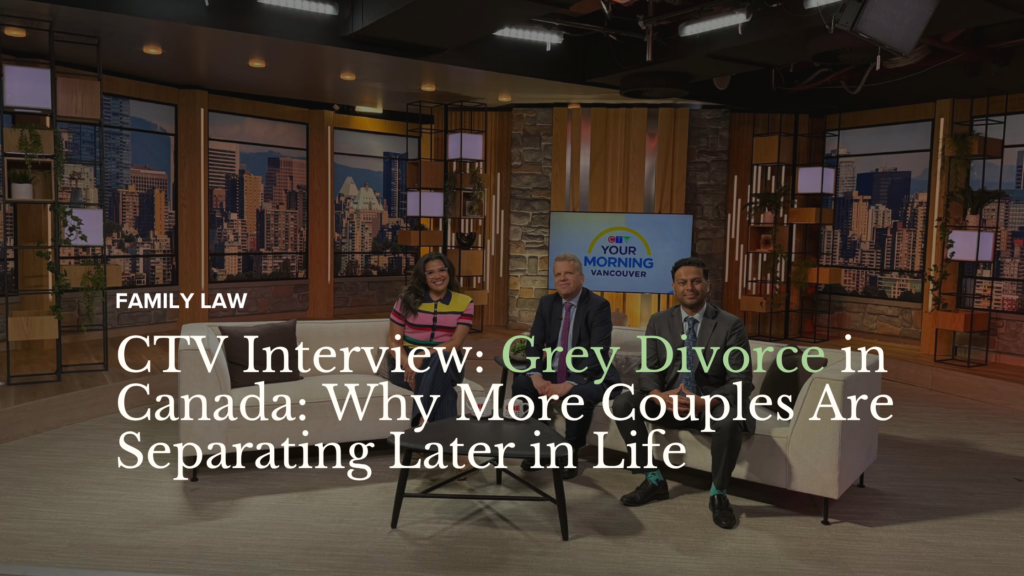
CTV Interview: Grey Divorce in Canada: Why More Couples Are Separating Later in Life

Grey divorce—separation later in life—is a growing trend that brings unique legal and financial challenges. In this CTV Your Morning interview, Laurence Klass and Shashika Stanislaus provide expert legal advice on navigating divorce after 50, including how to protect retirement savings, divide assets, and avoid costly mistakes. Whether you’re planning ahead or currently facing a late-life separation, understanding your legal rights and financial options is essential for long-term stability.

Read More
  • Family Law

Factors Indicating a Marriage-Like Relationship in British Columbia: “Are we considered spouses?”

Tiara Cunningham,Keita Szemok-Uto

It’s one of the most common questions in British Columbia family law.
In BC, a relationship does not need a wedding, registry, or even the label “common law” to attract legal rights and obligations. When a couple separates, courts may find that they were in a marriage-like relationship, triggering potential claims for property division, spousal support, and other rights under the Family Law Act.

Read More

Our lawyers can help you take action.

Learn how the Hague Convention applies to international child abduction cases in BC.